
Long-Haul Travel and Sleep: What Jet Lag Does to Your Sleep and How to Recover - Guest article by Tori Cooper, CBT-I Practitioner

I'm Tori Cooper a CBT-I practitioner, member of The Sleep Charity UK and UKIHCA Registered Health Coach helping people whose sleep problems interfere with their daily lives, whether it's chronic insomnia, sleep anxiety, or simply that you’re never quite satisfied with your sleep.
I'm delighted to be contributing to the Rhythm and Routes blog and excited to be working with Rhythm and Routes on a sleep retreat for later this year, so do watch this space.
You've landed. It's 9am on Monday, the day after you’ve arrived and you still feel like it's the middle of the night. You tell yourself to push through. You do, but you're not really at full capacity.
It might be that you’re feeling foggy and flat, not feeling sharp enough when it matters most. Or just a sense you don’t have your usual levels of resilience to manage everything you need to. The good news is this doesn’t just have to be part of the experience. Maybe you’ve tried melatonin, avoided wine on the plane, and attempted to sleep at the right times. Nothing seems to help. Typically, this is because it’s focusing on the symptoms instead of understanding what's really going on. Hopefully, once you know that, you can manage it better.
Your body has its own clock, and it doesn’t care about your itinerary.
Most people understand that jet lag has to do with time zones. What’s less clear is what's happening beneath the surface.
Your body operates on a roughly 24-hour cycle called the circadian rhythm. It controls when you feel awake and when you feel sleepy, when your body temperature changes, and when it releases hormones like cortisol and melatonin. A tiny area in your brain manages this rhythm. Light, especially morning light, is important to this rhythm.
When you fly across several time zones, your internal clock continues ticking on home time. Your body thinks it’s 3am when the conference room is bright and someone expects you to be alert. This mismatch between your body's expectations and the world’s demands is jet lag.
Your body will adjust of course, but it takes time. The rule of thumb is about one time zone per day. Which means a six-hour eastward flight could leave you struggling against your biology for nearly a week.
Flying east is usually harder than flying west, I’ve experienced this personally on trips to Australia and New Zealand. Going east forces your body to advance its clock, making you wake and sleep earlier than it naturally prefers. Our circadian rhythm has a slight tendency to delay, which makes it easier to stay up late than to go to bed early. Westward travel aligns with that tendency, while eastward travel fights it.
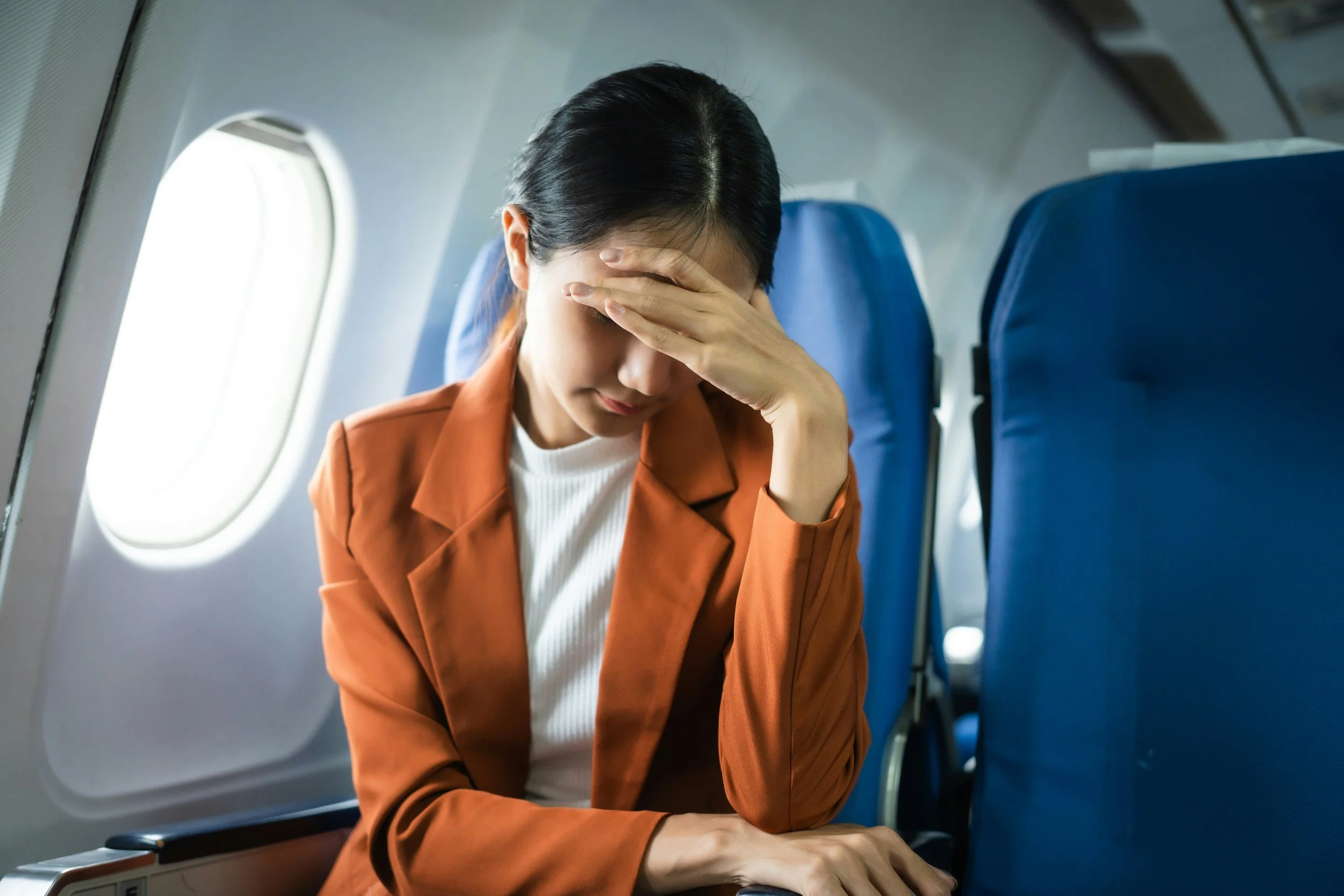
Tiredness and Sleep Issues when Travelling
What’s actually happening in your brain?
It's easy to see jet lag as just fatigue. However, research paints a clearer picture.
Sleep disruption impacts working memory, emotional control, and the careful thinking most often required for work. One surprising finding when it comes to not having enough sleep, is how sleep deprivation affects risk assessment. You don’t just get slower; you also become less able to recognise your own lack of responsiveness. You might feel fine, but often, you’re not.
The effects are rarely extreme, so you might not even be aware of the link. They show up as ideas that fall flat, a shorter temper, and less thorough decision-making than usual. It’s not catastrophic, just a steady, invisible drop in your performance when you need to be at your best.
Why the most common jet lag advice doesn’t work
The usual recommendations to stay hydrated, avoid alcohol, and try melatonin aren't wrong, but they treat jet lag like a hydration issue or something that can be fixed with the right product. A more effective approach focuses on behaviour, starting with understanding two key concepts about how sleep works.
1) Sleep pressure
Your body builds a need for sleep the longer you stay awake. Sleep researchers refer to this as homeostatic drive, or sleep pressure. It rises throughout the day and peaks at your usual bedtime. After crossing eight time zones, when your body thinks it’s 3am, that pressure feels intense, but it arrives at the wrong local hour.
The urge for a nap upon arrival is strong and reasonable. The issue is that a long nap reduces the sleep pressure you need to sleep well that night. One poor night makes the following day tougher, which makes the next night even harder, and suddenly, you're three days in and still out of sync.
What works better, although it's not easy, is to hold on. Stay awake until a reasonable local bedtime, even if you're exhausted. This builds the sleep pressure needed to anchor that first night and start genuinely shifting your clock forward.
2) Light is the most powerful tool you have
Your circadian rhythm resets with light, mainly natural sunlight. This is the lever that many jet lag strategies fail to use effectively.
Getting outside in bright morning light after an eastward flight is one of the best ways to help your body adjust. If you're travelling west and need to delay your clock, avoid bright light in the early morning and seek it in the late afternoon to move things in the right direction.
I know this sounds almost too simple for such a challenging problem. However, the evidence regarding light exposure and circadian adjustment is solid. A twenty-minute walk outside in the morning does more to reset your clock than many supplements, and it costs nothing.
Combining these two aspects; sleep pressure and your circadian rhythm, is key to resetting your system as fast as possible.

Soaking in early morning light
Create a consistent wind-down routine at home and while away
Another anchor of good sleep is consistency in your wind-down routine. This principle comes from CBT-I, the therapy I use with clients dealing with insomnia. One of its core tools is stimulus control: creating a strong mental link between your bed and sleep, and removing the association of being in bed and being awake. This makes your bed a cue for your body to calm down. One person I was working with, who had been spending long stretches awake during the night, told me ‘Tori, I can hardly even look at my bed now without feeling sleepy’ so it does absolutely work.
However, frequent travellers disrupt this link constantly. Different beds, environments, and time zones create interruptions that need strengthening, not weakening.
The practical solution is simpler than it seems.
Keep your pre-sleep routine as consistent as possible wherever you are. Follow the same order; a shower, some reading, a few minutes of deep breathing, or whatever works for you, so your body knows sleep is on the way.
When done regularly, it becomes a true anchor. Unfamiliar rooms will matter less because you've brought the cue with you.
If you wake in the night and can't drift back off within 15 to 30 minutes, the best thing you can do is get out of bed (or sit up in bed if getting out isn’t an option) and read a book using a dim warm light, so as not to activate your circadian rhythm.
If you don’t have a book on the go simply do anything that captures your attention but is not overly stimulating, such as listening to a podcast or some easy Sudoku. As soon as you feel sleepy again, go back to bed, lie down and return to sleep.
When jet lag is pointing at something else
For most frequent travellers, understanding the science and making a few targeted changes is enough. Sleep adjusts, performance improves, and travel becomes manageable again.
However, sometimes, jet lag highlights an existing sensitivity to sleep challenges. Unfortunately, some of us are just wired to be more likely to have a fragility in our sleep.
If you find it hard to sleep even at home, if you dread bedtime, or if worry about being tired feels bigger than the tiredness itself, take that seriously instead of blaming it solely on your schedule.
CBT-I is the recommended treatment by the NHS, the National Institute for Health and Care Excellence (NICE) and sleep researchers worldwide for these patterns, ahead of medication. It's structured, limited in time, and backed by strong evidence.
If anything here resonates beyond jet lag, I’m always here for a conversation.
If you want to know more or discuss what might help your sleep, feel free to get in touch